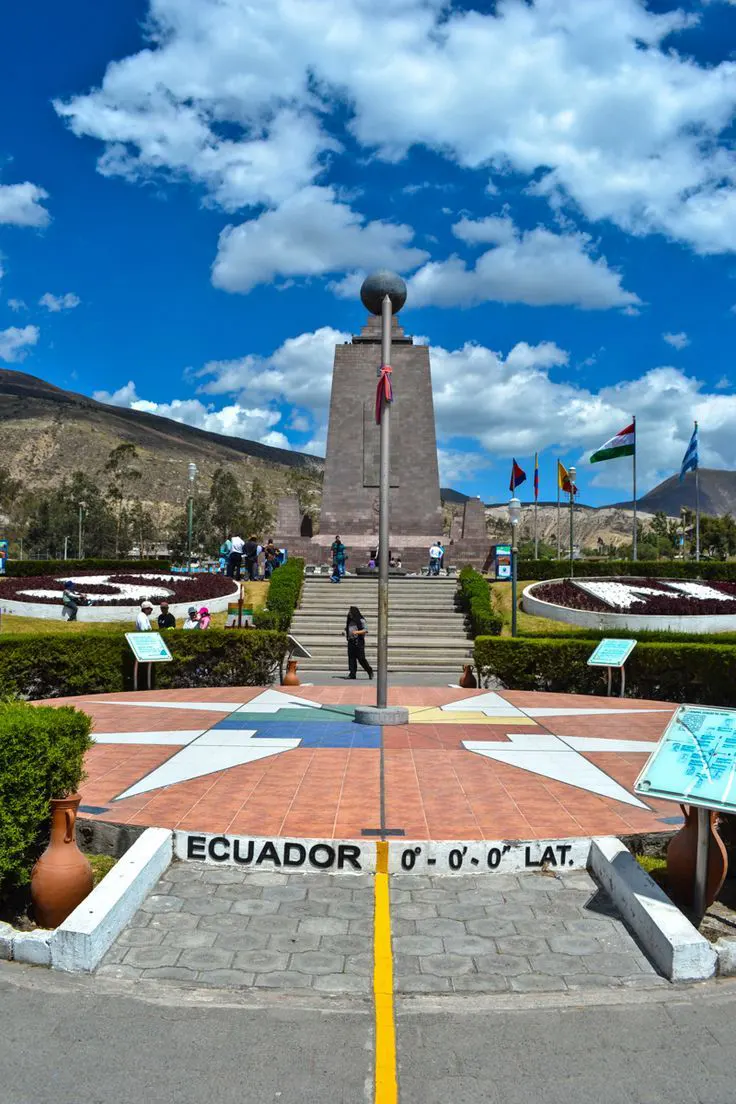
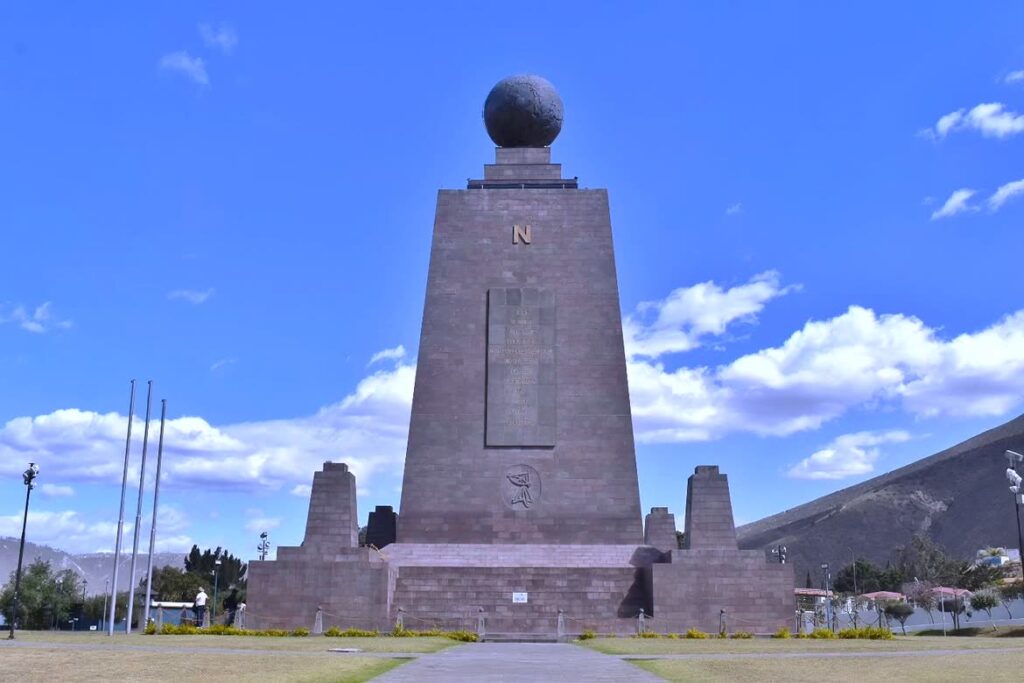
Standing with one foot in the Northern Hemisphere and the other in the Southern is one of the classic moments of a trip to Ecuador, a country named after the line itself. Just north of Quito, the Ciudad Mitad del Mundo (Middle of the World City) marks the equator with a 30-metre monument, museums and a yellow line across the plaza. A few hundred metres away, the Intiñán Museum sits on the line measured by GPS.
In short: the Middle of the World is about 25 km north of Quito’s historic centre, 45 minutes to an hour by road. Allow two to three hours. The monument was placed using 18th-century measurements, and the GPS equator runs about 240 metres to the north, so many visitors see both sites on the same morning.
Ways to visit the equator near Quito
| Site | What it is | Time needed |
|---|---|---|
| Ciudad Mitad del Mundo | The official monument, the yellow line, museums, a planetarium and a scale model of Quito | 1.5 to 2 hours |
| Intiñán Solar Museum | A small open-air museum next door, on the GPS line, with guided demonstrations and exhibits on Andean cultures | About 1 hour |
| Pululahua crater | A viewpoint over a volcanic crater with farms on its floor, a few kilometres away | 30 minutes at the viewpoint |
| Quitsato sundial | A large sundial on the equator near Cayambe, north-east of Quito | Half a day from Quito |
Is the Mitad del Mundo on the real equator?
Not exactly. The line at the monument follows the measurements of the French Geodesic Mission of the 18th century, which were remarkably accurate for their time. Modern GPS places latitude 0°0′0″ about 240 metres north of the yellow line. The Intiñán Solar Museum, a short walk away, is built on the GPS line and is the place to stand on the “real” equator.
Both are worth seeing: the monument for its history and the photo, Intiñán for the line itself. At Intiñán, guides show water draining in opposite directions on each side of the line and invite you to balance an egg on a nail. These are good fun but showmanship: the Coriolis effect is far too weak to decide the direction of water in a basin, and an egg can be balanced anywhere with patience.
A brief history of the equator in Ecuador
The ancient peoples of Quito
Long before satellites and GPS, the peoples of the northern Andes followed the sun with great precision. Researchers have suggested that sites such as Catequilla, a hill near the Mitad del Mundo, were aligned with the equator and the solstices, and the name “Quito” is often said to come from words meaning “middle” and “earth”.
The French Geodesic Mission of 1736
In the 18th century scientists were divided over the shape of the Earth. In 1736 the French Academy of Sciences sent an expedition to the Audiencia of Quito, led by Charles Marie de La Condamine, Pierre Bouguer and Louis Godin and joined by the Spanish officers Jorge Juan and Antonio de Ulloa, to measure a degree of latitude at the equator. After almost a decade of work in the mountains, their results helped prove that the Earth is not a perfect sphere but flattened at the poles and wider at the equator.
That bulge explains one of Ecuador’s favourite facts: because it sits so close to the equator, the summit of Chimborazo, at 6,263 m, is the point on the Earth’s surface farthest from the centre of the planet, about 2 km farther than the summit of Everest. For more of what makes the country special, see our top reasons to travel to Ecuador.
The monument
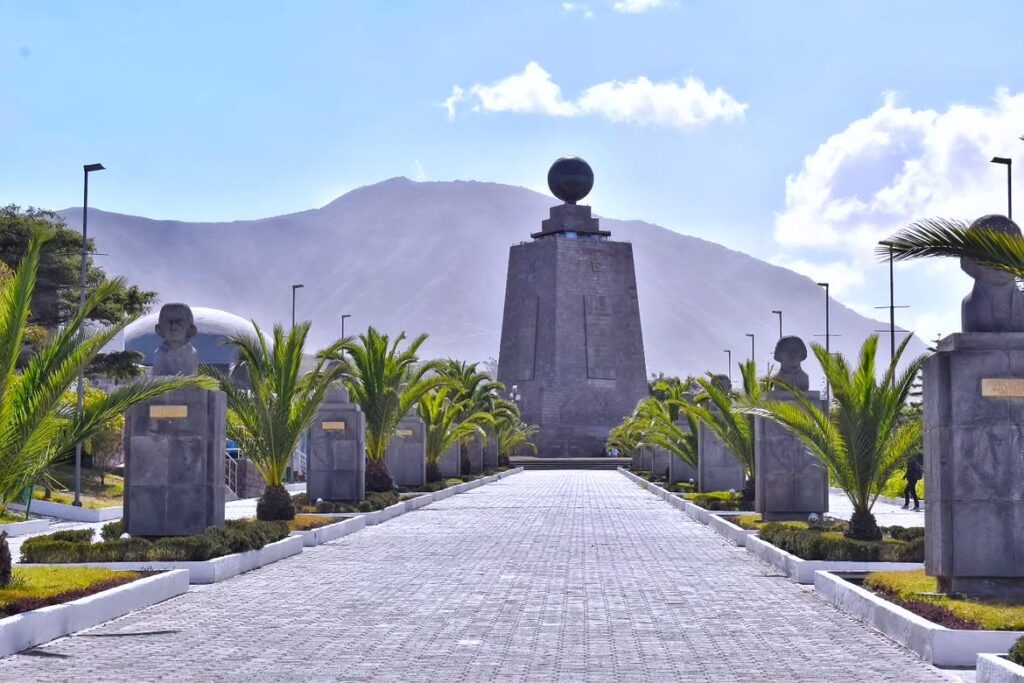
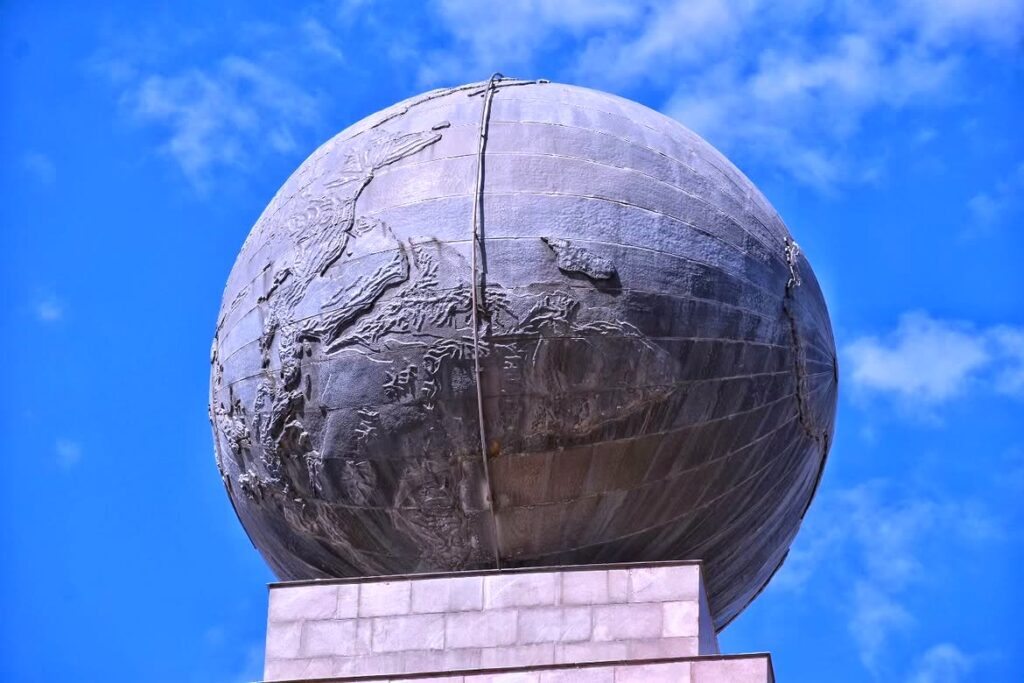
The first monument was raised in 1936, for the 200th anniversary of the mission; it now stands in the nearby town of Calacalí. The present 30-metre monument, topped by a globe, was completed in 1982. It stands at the centre of a small “city” of museums, shops, cafés and squares, with busts of the scientists of the mission along its main avenue.
What to see at the Ciudad Mitad del Mundo
- The equator line and the monument: the classic photo with one foot in each hemisphere.
- The ethnographic museum inside the monument: the peoples and cultures of Ecuador, with a viewing platform at the top.
- The scale model of Quito: a bird’s-eye view of the colonial centre you visit the same day.
- The planetarium and pavilions: astronomy shows and exhibitions on the geodesic mission.
- Cafés and craft shops: chocolate, coffee and crafts from all over Ecuador. At weekends there is often music and dance on the main square.
Entrance fees and opening hours
| Admission | Opening hours |
|---|---|
| About US$5 for adults and US$2.50 for children; some museums and the monument’s viewing platform may cost extra | Usually 9:00 am to 6:00 pm, every day |
Prices and hours can change, so check them before you go. Intiñán has its own entrance fee, and visits are guided.
How to get to the equator from Quito
- On a guided day: the easiest way. Our journeys through Ecuador combine the Middle of the World with a tour of Quito’s colonial centre (see below).
- Taxi or ride-hailing: about 45 minutes to an hour from the historic centre, depending on traffic. Agree the price, or a return pick-up, before you go.
- Public transport: take the Metrobus to the La Ofelia terminal in the north of Quito, then a local bus marked “Mitad del Mundo”, which stops outside the site. Cheap, but allow about 1.5 hours each way.
Tips for your visit
- Sun protection: at about 2,480 m and on the equator, the sun is very strong even when it is cloudy. Bring a hat and sunscreen.
- Go in the morning: the sky is usually clearer before midday, and the site is quieter.
- The equinoxes: around 21 March and 23 September the sun passes directly overhead at noon and objects cast almost no shadow. The Mitad del Mundo holds events on those days.
- Add Pululahua: the crater viewpoint is only a few minutes away and needs half an hour.
The Middle of the World on our journeys
Three of our journeys spend a full day in Quito that combines the colonial centre (Plaza Grande, La Compañía, San Francisco and El Panecillo) with the Middle of the World, where you stand on the equatorial line, and an artisanal chocolate workshop to learn about Ecuador’s fine aroma cacao:
- Ecuador & Peru Highlights (15 days): Quito and the Galápagos, then Machu Picchu.
- Treasures of Ecuador & Galápagos (14 days): Quito, the Andes of Ecuador and the Galápagos.
- Signature Journey (29 days): from Quito and the Galápagos to Peru, Bolivia, Argentina and Brazil.
For more on the country, see our Ecuador travel guide and the Galápagos Islands.
Frequently asked questions
Is there a real equator line in Ecuador?
Yes. The equator crosses the north of Ecuador, just north of Quito. The line at the Mitad del Mundo monument is about 240 metres south of the GPS equator, and the nearby Intiñán Museum sits on the GPS line.
What part of Ecuador is on the equator?
The equator crosses the province of Pichincha just north of Quito, runs past the Cayambe volcano, whose southern slope is the highest point on the equator, at about 4,690 m, and crosses Isabela Island in the Galápagos.
Does Quito sit on the equator?
Almost. Quito is about 25 km south of the equator, which makes it the closest capital city to the line. The Middle of the World is a short drive north of the city.
How long do you need at the Middle of the World?
Two to three hours for the monument and Intiñán, or half a day with the Pululahua crater. It combines well with a morning in Quito’s colonial centre.
Does water drain differently on each side of the equator?
Not in a basin. The Coriolis effect only shapes very large systems, such as hurricanes. The demonstrations at Intiñán are entertaining, but the direction of the water depends on the shape of the basin and how it is poured.
How much does it cost to visit the Mitad del Mundo?
About US$5 for adults and US$2.50 for children, with extra fees for some museums and the viewing platform. Intiñán charges its own fee. Check the current prices before you go.
Ready to Experience This Firsthand?
Our travel consultants design your itinerary around your dates, pace and hotel style.

Wilfredo Zúñiga Huamanguillas
Anthropologist & Hospitality Professional | South America Travel ExpertAnthropologist, hospitality professional and South America travel expert with 11 years of experience in tourism, trained at the Universidad Nacional de San Antonio Abad del Cusco. Wilfredo writes about the people, traditions and landscapes of the continent, from the Andes and Machu Picchu to Patagonia, Brazil and the Amazon.
More about Wilfredo →