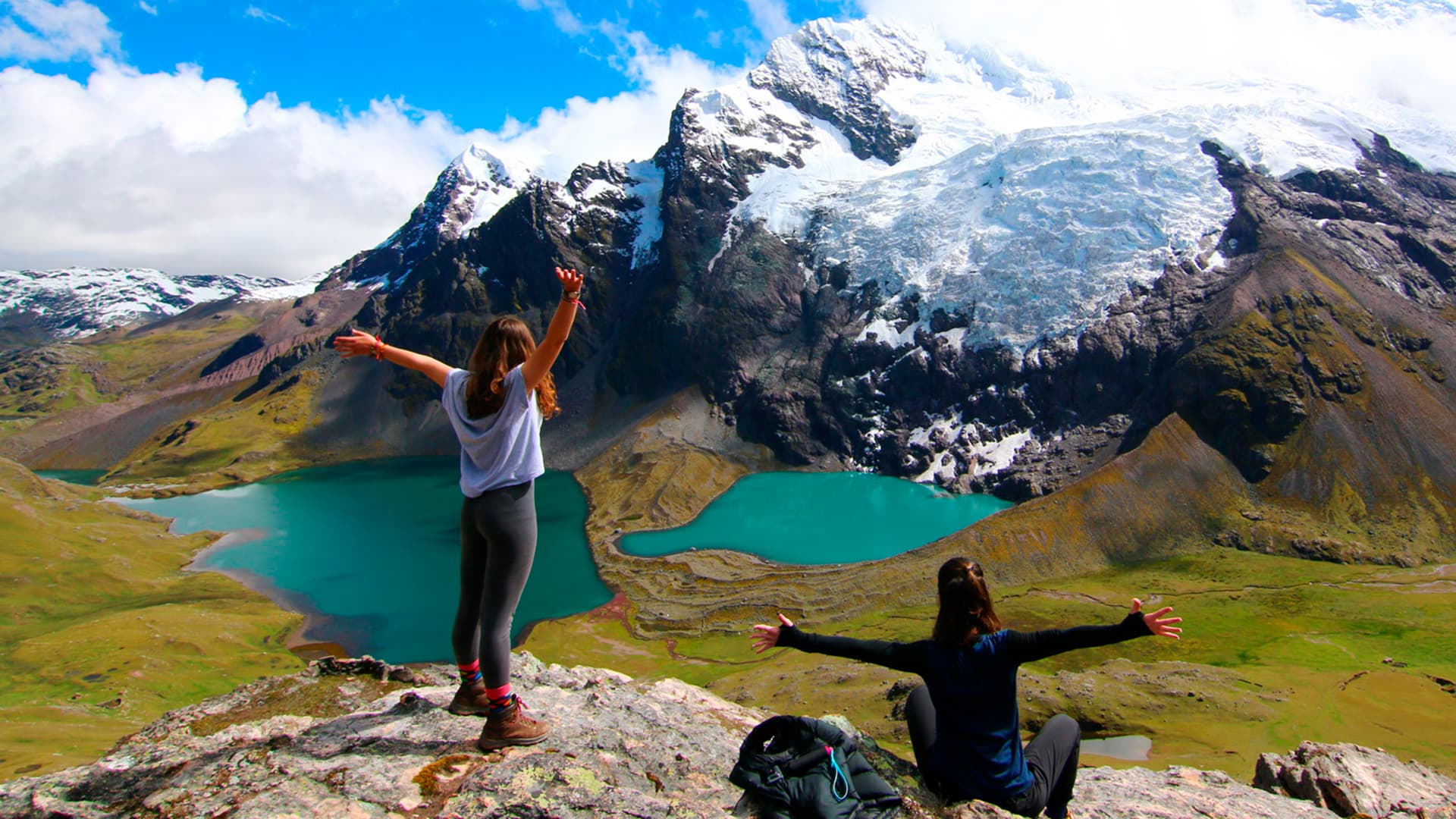
The 7 Lakes of Ausangate (Siete Lagunas) are a chain of turquoise, green and deep-blue glacial lakes below Ausangate, the highest mountain in southern Peru. The day hike from the village of Pacchanta is one of the most rewarding walks in the Andes: quieter than Rainbow Mountain, with herds of alpacas, Quechua herding families and the glaciers of Ausangate always in view. This guide covers where the lakes are, the altitude, the best season, how the hike compares with Rainbow Mountain and Humantay Lake, how to prepare, and where it fits on a longer trip through Peru and Bolivia.
Where are the 7 Lakes of Ausangate?
The lakes are in the Ausangate range, in the province of Quispicanchi, about 120 kilometres south-east of Cusco. The drive to the trailhead takes about three hours, through the valley of the Vilcanota and the highland towns of Urcos and Ocongate. The hike starts at Pacchanta, a herding community at about 4,200 metres, known for its natural hot springs.
Above it rises Ausangate, about 6,384 metres (20,945 feet) high and sacred to the Andean communities of the region: it is the mountain of the Qoyllur Rit’i pilgrimage, held every year before Corpus Christi.
The hike at a glance
| Detail | 7 Lakes of Ausangate |
|---|---|
| Start | Pacchanta, at about 4,200 m |
| Highest point | Above 4,600 m |
| Hiking time | About four to five hours on a loop past the lakes |
| Difficulty | Moderate to demanding, mainly because of the altitude |
| Total day | A long day from Cusco, leaving before dawn |
| Best season | May to September, the dry season |
Why are the lakes turquoise?
The lakes are fed by the glaciers of Ausangate. As the ice moves, it grinds the rock into a very fine powder, known as rock flour, that stays suspended in the water and reflects the light. Each lake has a different depth and amount of sediment, which is why the colours change from turquoise to emerald and deep blue, and shift through the day with the sun.
Weather and the best time to go
The dry season, from May to September, has the clearest skies and the most reliable trail conditions; June to August are the driest months. Days are bright but the wind is cold, and nights at Pacchanta fall well below freezing. From December to March the rain and afternoon storms bring clouds over the mountain, and some days snow covers the trail, although the hills turn green and the wildflowers bloom.
For the whole country, see our guide to the best time to visit Peru.
7 Lakes, Rainbow Mountain or Humantay Lake?
These are the three great high-altitude day hikes from Cusco. All three need good acclimatisation; the difference is in the scenery and the number of people.
| Hike | Highlights | Highest point | Crowds |
|---|---|---|---|
| 7 Lakes of Ausangate | Seven glacial lakes, Ausangate’s glaciers, alpaca herds and hot springs | Above 4,600 m | Few people |
| Rainbow Mountain (Vinicunca) | The striped mountain and the Red Valley | Above 5,000 m | Very busy in the morning |
| Humantay Lake | A turquoise lake below Humantay glacier, on the Salkantay route | About 4,200 m | Busy |
If you want the colours of Rainbow Mountain without the crowds, the 7 Lakes are the better choice. Humantay Lake is the shortest and the easiest to combine with a few days in Cusco and the Sacred Valley.
How to visit the 7 Lakes
As a day hike
Most travellers visit on a long day from Cusco: an early departure, the hike around the lakes with a local guide, lunch and, if time allows, a soak in the hot springs at Pacchanta before the drive back. Horses can be hired in Pacchanta for part of the climb.
As part of a trek
The lakes are also on the Ausangate Trek, a classic circuit of five to six days around the mountain with high passes above 5,000 metres, camping and the support of local muleteers. It is for experienced hikers who are fully acclimatised.
Would you like to include the 7 Lakes in a tailor-made Peru journey? We organise it with your own guide and transport from Cusco, and fit it around the rest of your days in the region.
The 7 Lakes on a multi-country trip
The 7 Lakes are higher than almost anywhere on a classic route through Peru and Bolivia: the trail climbs above 4,600 m, about 1,200 m above Cusco, and only the Southern Lípez, between Uyuni and the Atacama, reaches similar heights. So the hike belongs late in your time around Cusco, never on arrival.
- When: after at least two or three nights at Cusco’s altitude. On most of our journeys with Peru, the free day in Cusco after the Machu Picchu and city days is the natural slot.
- Before Bolivia: on routes that continue to Lake Titicaca, La Paz and Uyuni, the hike comes just before the highest part of the trip, so plan an easy day afterwards.
- A gentler alternative: our Peru, Bolivia, Chile, Argentina & Brazil Explorer (35 days) includes a day at Palcoyo, a quieter rainbow mountain where a walk of about 45 minutes leads to viewpoints with Ausangate in the distance.
- Check your route: our altitude planner shows how high you sleep each night on every journey.
See where Cusco falls on each route
Overland, train or boatFlight
- 1Lima 2 nights
- 2Puerto Maldonado (Amazon) 2 nights
- 3Sacred Valley 2 nights
- 4Machu Picchu day trip
- 5Cusco 3 nights
- 6Puno (Lake Titicaca) 2 nights
- 7La Paz 2 nights
- 8Uyuni 1 night
- 9Southern Lípez 1 night
- 10San Pedro de Atacama 3 nights
- 11Santiago 2 nights
- 12Mendoza 3 nights
- 13Bariloche 3 nights
- 14Buenos Aires 3 nights
- 15Iguazú Falls 2 nights
- 16Rio de Janeiro 3 nights
Plants and wildlife
- Ichu grass: a tough, spiky bunch grass that covers the high grasslands and feeds the herds.
- Queñual trees: Polylepis woodlands on rocky slopes, among the highest-growing trees in the world.
- Llamas and alpacas: the herds of the Pacchanta families graze around the lakes.
- Vicuñas and viscachas: wild relatives of the llama and rabbit-like rodents among the rocks.
- Andean condors: sometimes seen riding the air currents above the valley.
Tips for the hike
- Acclimatise first. Spend at least two or three days in Cusco (3,400 m) or the Sacred Valley before the hike.
- Dress in layers. A base layer, a fleece, a windproof and waterproof jacket, a hat and gloves.
- Protect yourself from the sun. Sunscreen, sunglasses and a hat: the sun is very strong at this altitude.
- Drink water and walk slowly. Carry at least two litres and take your time on the climbs.
- Bring cash in small notes. The community charges a small entrance fee, and you may want to hire a horse.
- Respect the community. Ask before taking photos of people, and take your rubbish back with you.
Frequently asked questions
Is the 7 Lakes of Ausangate hike worth it?
Yes. It combines glacial lakes, one of the great mountains of the Andes and Quechua herding life, with far fewer people than Rainbow Mountain.
How difficult is the 7 Lakes hike?
Moderate to demanding. The path is not technical, but it stays above 4,200 metres and climbs past 4,600, so the altitude is the challenge.
How high is Ausangate?
About 6,384 metres (20,945 feet), the highest mountain in the Cusco region and in southern Peru.
Is it better than Rainbow Mountain?
It is quieter, lower and has more variety: lakes, glaciers and hot springs. Rainbow Mountain is higher and more famous, but it is very busy in the morning.
When is the best time to visit?
May to September, the dry season, with the clearest skies from June to August.
Can I combine it with Machu Picchu?
Yes. Hike the 7 Lakes after a few days in Cusco or the Sacred Valley, when you are acclimatised, and visit Machu Picchu before or after. For more ideas, see our list of things to do in Peru.
Can I add the 7 Lakes to a Peru and Bolivia trip?
Yes. The best moment is the free day in Cusco, after a few nights at altitude and before Lake Titicaca and Bolivia. Tell our travel experts when you enquire and we will fit it into your route.
Ready to Experience This Firsthand?
Our travel consultants design your itinerary around your dates, pace and hotel style.

Wilfredo Zúñiga Huamanguillas
Anthropologist & Hospitality Professional | South America Travel ExpertAnthropologist, hospitality professional and South America travel expert with 11 years of experience in tourism, trained at the Universidad Nacional de San Antonio Abad del Cusco. Wilfredo writes about the people, traditions and landscapes of the continent, from the Andes and Machu Picchu to Patagonia, Brazil and the Amazon.
More about Wilfredo →